Is wheat killing us?
Introduction
Maybe you've heard someone say, "Well, in Asian countries they eat low fat diets and they don't have many heart attacks." This is mainly, mostly true. But interestingly, "The China Study", a recently published book by T. Colin Campbell, a leading researcher into diet and disease in China has one chapter about heart disease and it doesn't even MENTION China. How can that be? In a nutshell, Dr. Campbell is a vegan propagandist that will string together any number of flimsy correlations to support his cause, but not even he is bold enough to try to make it seem like there is a link between heart disease and animal food consumption - meat, milk and eggs - in China. Clearly, there is not.
I am fascinated by "The China Health Study". The whole thing was started in the early 1970's when the Chinese premier, Chou EnLai, was dying of cancer. He initiated a vast study correlating disease rates in China with different geographical areas, culminating in the publishing of a disease atlas of China. Later, the authors of The Study collected dietary and blood data from 65 mostly rural counties in China and correlated them with the data in the disease atlas. Then they printed the data in book form so that you can, for instance, look up myocardial infarction ( heart attack) rates, and see what foods are eaten in areas of China where people are prone to heart attacks. It is a truly epic study and I think it is far more interesting than most Western health studies because of certain factors in China:
1) The people in rural China eat what they grow, so the majority of people in the study have presumably eaten the same diet from birth to death. This contrasts with American diets which tend to change with the dietary breeze.
2) Due to wide variations in climate and therefore which crops can be grown, dietary staples differ by region. Rice is the staple in Southern China, wheat, corn and millet are staples in the middle latitudes and wheat and dairy predominate in the far North. There are pig-raising areas and sweet-potato raising areas. Therefore, we can see correlations of disease patterns among dramatically different diets.
3) There are dramatic differences in disease rates in different areas in China. The disease rates from region to region differ far more than they do in the US.
4) The authors published all of the tabulated data in a "monograph" titled, "Diet, Life-style and Mortality in China." Very few studies give you this type of unfettered access to the raw data. Usually, you only get the authors conclusions from their take on the raw data. You can probably find a copy and have a look yourself if you're REALLY interested.
The Meat of It
Unfortunately, we now have to talk about statistics for a minute. The data in the monograph is published with correlation scores between each pair of factors (like myocardial infarction and fat consumption). The scores range from -100 to 100. A score of 0 means that the two factors are completely unrelated, whereas a cc of 100 represents perfect correlation and a cc of -100 is perfect negative correlation. Come again? OK, so a cc of 100 between fish and myocardial infarction (MI) would mean that anyone who's ever tasted fish has died of a heart attack. That would be considered a "strong positive correlation". A cc of -100 would mean that no one who's tasted fish ever died of a heart attack. That's a "strong negative correlation". And a cc of 0 means that, from the perspective of MI, it made no difference whatsoever whether or not you've eaten fish (no correlation). Of course, in the real world the correlations tend to be a little more ambiguous.
OK, enough teasing. Here are the relevant correlations between dietary factors and MI:
| Factors Correlated to Heart Attack Risk (MI) | ||
|---|---|---|
| Factor | Correlation Score | Significance |
| Meat Consumption | -28 | none |
| Dairy Consumption | 6 | none |
| Rice Consumption | -58 | Strong Negative Correlation |
| Wheat Consumption | 67 | Strong Positive Correlation |
| Other Grain Consumption | 39 | Moderate Positive Correlation |
| Green Vegetable Consumption | 5 | none |
| Blood Cholesterol | 4 | none |
Whoah!! Did you catch that? I'll state it as plainly as I can:
The main dietary predictor of heart disease rates in China is the TYPE of grain you eat.
Rice eaters seem protected from heart attacks while wheat, corn and millet eaters are much more prone (the corn link is debatable). Meat, dairy and vegetable consumption play no obvious role. Blood cholesterol plays no role.
But we're not going to believe these statistics are we? Let's look at the raw data.

The first graph simply shows the raw correlation between eating grains other than rice and dying of a heart attack in China. There is a clear positive trend here. The counties with the nine highest rates of heart disease all eat more than 350 grams per day of grain other than rice. The majority of counties where more than 350 g/day of non-rice grain are eaten have a MI death rate of more than 7 per 100,000 per year whereas the majority of rice eating areas have heart disease rates of less than 4 per 100,000 per year.
A problem with any study of this magnitude is that there are so many variables. These variables are very, very tricky to tease apart, but I'll give it a go. In some areas of China, corn and millet are widely eaten. Since the link between wheat and heart disease is particularly strong, it would be interesting to see the link between rice and wheat consumption and heart disease in areas where corn and millet are not eaten. The following graph shows the relationship between wheat consumption and heart disease only in counties where they eat less than 100 grams per day of corn and millet.
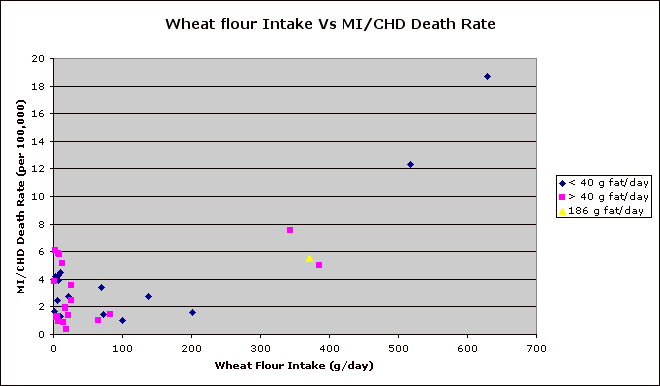
Wow, no question about the correlation here!
I'm also trying to tease out the effect of fat consumption. Notice that there are three data series in the graphs. The blue diamonds represent areas where total fat consumption is less than 40 grams per day. The purple squares represent areas where fat consumption is more than 40 grams per day. If fat consumption plays a role in heart disease risk, you would expect to see the purple squares a little higher than the blue diamonds, on average. But as you can see, this is not the case, suggesting that it doesn't matter how much fat is eaten; in China, the more wheat you eat the greater your risk of heart disease, regardless of fat consumption.
The final data point, the yellow triangle, is Tuoli county, where 186 grams of fat are eaten per day, mostly from dairy and meat. If dietary fat plays a role in heart disease risk in China, you would expect that point to be elevated far above the others. It is not. Which brings me to my next topic.
The Forgotten Ones
There are populations in China in and around the steppe whose diets are more American than here in the good ole US of A. They eat wheat, dairy products and meat. And nothing else. You can read about some of them here, but I'll give you this quote as a prelude:
"The vegetables were, incidentally, an accommodation to the visiting lowlander. Self-respecting nomads don't eat plants; it's just not their place on the food chain."
I don't think the people studied in the China Health Study are actually nomadic, but they eat far more saturated fat than we do in America - most of it from dairy and meat. Yet, as you can see by the location of the yellow triangle in the graph, their rates of heart disease seem to be determined solely by how much wheat they eat.
Why do I refer to them as the forgotten ones? In this interview, Dr. campbell had this to say, "Firstly, the kind of diet that was consumed in China is very low in total fat. The range was between 6-24% of calories, for example, whereas in this country the range is more of the order of the high 20s-high 40s. " Actually, the fat content of the diet of the people of Tuoli, according to Dr. Campbell's study, was 45%. Has he forgotten them? My guess is that he simply prefers not to think about them. They don't support his views, you see.
Here's a table comparing three wheat eating areas and the Chinese averages. I have picked three areas with extreme diets to prove my point. The first is Longxian county, the area of China with the highest wheat consumption and below average meat and vegetable consumption, a very tedious diet by American standards. The next is Tuoli, where wheat is eaten along with large portions of meat and dairy but no vegetables. This area represents the stereotypical american diet. The final is Jingxing, an essentially vegan area where they eat a variety of grains other than rice and gorge themselves on green vegetables. Jingxing had by far the highest consumption of green vegetables of any county in this study. I suppose it represents the ideal vegan diet of low fat consumption with lots of vegetables and grains (except rice).
| Three Chinese Counties | ||||
|---|---|---|---|---|
| Longxian | Tuoli | Jingxing | Chinese Median | |
| Rice Cons (g/day) | 0 | 3.9 | 6.1 | 398 |
| Wheat (g/day) | 629 | 372 | 126 | 22.4 |
| Other Grain (g/day) | 75.1 | 6.8 | 342.1 | 1.1 |
| Meat (g/day) | 6.1 | 121 | 0 | 20.3 |
| Dairy (g/day) | 0 | 857 | 0 | 0 |
| Green Veg (g/day) | 36.3 | 0 | 691 | 76.8 |
| MI/CHD | 18.7 | 5.53 | 11.9 | 3.16 |
| Stroke | 61.2 | 34.3 | 42.3 | 25.2 |
As you can see, Tuoli county had the lowest levels of heart disease and stroke (which is also correlated with wheat consumption) of the three. The three counties followed the general trend:
In China, the more non-rice grain you eat, the higher your risk of heart disease (and stroke). Eating meat, dairy and vegetables don't affect your risk.
Discussion
Correlation does not imply causation. What this study does NOT tell us is that wheat categorically causes heart disease. It tells us that there is something different about wheat eating people in China that predisposes them to heart disease, which may or not be the wheat itself. For instance, in the study the number of times per year than one ate green vegetables had a strong negative correlation with heart disease risk while the number of times per year that one ate carrots had a strong positive correlation correlation. Should we conclude from this that green vegetables prevent heart disease while carrots cause it? No. First off, the actual amounts of carrots or green vegetables consumed have no correlation with heart disease risk. These two parameters are actually telling us about the length of the growing season in an area. In the South, green vegetables can be grown for more of the year, while in the North carrots have to be grown since they can be kept in a root cellar during the longer winter. Rice growing is confined to the warmer South. So the reason that there is a strong correlation between how often you eat carrots and heart disease risk is that carrots are eaten in wheat growing areas. Wheat is the REAL correlation.
But if you want to show that wheat is really the cause of elevated heart disease risk and not just a marker for something else, you have to look a little deeper. And in China, there are a whole bunch of differences between wheat and rice eating peoples. Wheat eating people are taller and heavier. They tend to have higher levels of blood triglycerides, associated with increased risk of heart disease in the US, and sex hormone-binding globulin(shbg), which the authors of the study claim is a sensitive indicator of insulin resistance. Cholesterol levels were the same in both populations. Wheat eaters had lower levels of monounsaturated fats (like in olive oil) in their blood cell membranes and higher levels of omega 6 fats (like in soybean oil).
So a reasonable possibility, based on the triglyceride and shbg data is that eating wheat and certain other grains leads to insulin resistance, which is associated with increased heart disease risk. But the really interesting thing is why that should be. Why does eating wheat, but not rice, seemingly lead to insulin resistance in China? I don't know. That, my friends, is the million dollar question that we should be asking but aren't.
Where is T. Colin Campbell on this? He doesn't even MENTION the fact in his book! It's not like he didn't notice. His name is on the paper about it from 1996. The only reasonable explanation is that Dr. Campbell is more interested in pushing his agenda than on doing good science.
East and West
Might the difference between heart disease levels in Asia and Western countries be explained by the fact that Western peoples eat more wheat and Asian peoples eat more rice? Maybe partially. It's important to note that even in wheat eating areas of China, heart disease levels were still below those of Western countries.
If the causal link does indeed turn out to be insulin resistance, then there is one other major dietary difference that ought to be noted. In China, virtually no sugar is eaten, so there is nowhere in this study where the carbohydrate intake is similar to the US. In the US, we eat about the same amount of white wheat flour and sugar (or high fructose corn syrup) and not much else as far as carbs. In China they eat rice or wheat or maybe rice and millet or corn and wheat but never wheat and sugar. What if they did?
Conclusion
In China, the main predictor of heart disease rates in a given population is how much wheat flour (and other grains except rice) that population eats. The consumption of vegetables or animal products doesn't play an obvious role in heart disease rates. Tuoli county, where they eat far more saturated fat than in the US, had far less heart attack deaths than the US and no more heart attack deaths than you would suspect based on the amount of wheat they consume compared to their Chinese Colleagues.
A Few Notes
A couple more notes. Sweet potatoes, widely eaten in China, had a neutral effect on heart disease risk.
Apparently, in China, they eat mainly white flour and white rice, so this probably isn't a whole grain versus processed grain issue, although you could argue that the wheat, being ground into flour, is more processed than the whole white rice.
The study didn't publish any figures on physical activity, but it is clear that the Chinese get more physical activity and are less overweight than their Western counterparts. This is interesting in that it may help explain the overall differences between Asia and Europe, but I don't think it affects the relationship between wheat or meat and heart disease. I have no reason to believe that rice eaters got more physical activity than wheat eaters or that meat eaters had more physical activities than non meat eaters.
Some notes about comparing CHD rates in China and Europe/US. The statistics in this paper are done in a much different manner than are the CHD statistics available from the British Hearty Foundation, so the numbers in this article and "The Axis of Paradox" are not comparable. Not being a statistician, I'm not really sure how these CHD rates compare to the ones in Europe, but I'll trust Dr. Campbell on this issue that the areas with the highest CHD levels in China are still lower than European levels. One probable reason for that is that the Chinese life expectancy is significantly shorter than the European life expectancy and the leading causes of death in this study were infectious diseases such as tuberculosis. But you have to die of something, so presumably if infectious diseases in China were cured, life expectancy rates would increase and more people would die of heart attacks.
The Chinese in this study died much more frequently of strokes than heart attacks, which is common in Asian countries. In Asia it is considered honorable to die of a stroke but dishonorable to die of a heart attack, so the bias of the doctors when the cause of death is in doubt in to call it a stroke rather than a heart attack. Presumably the bias of Western doctors is the opposite. I have no idea if there is a real difference where Asians have more strokes and Westerners have more heart attacks (I presume there is), but it's interesting food for thought.
posted by Brad Marshall at 6:53 PM



351 Comments:
A few points which may be key to working out this China thing:
Unless prepared correctly grains and legumes contain phytic acid which combines with key minerals, especially calcium, magnesium, copper, iron, and zinc and prevents their absorption in the intestinal tract.
I do wonder whether all of the flour in China was being eaten WHITE or whether really they were eating a lot of it whole wheat.
The phytic acid is contained in the bran, so perhaps one thought might be that the phytic acid in whole wheat flour prevents absorption of many nutrients in a meal, whereas white rice, which does not have phytic acid, does not cause this problem, and hence other nutrients in the meal are utilised as normal, hence leading to the link between flours and CHD, and the higher amount of phytic acid in wheat flour versus other flours accounting for the greater link. Possible I'd say, but you'd need to check this out.
Grains/legumes either need to be soaked for 6-8 hours in salt or using some acidic medium such as whey, or sprouted, in order to neutralise the phytic acid and render them digestible.
Many grains used to sprout before or during the old fashioned harvesting processes. Now, in our industrialised age, stuff doesnt get the opportunity, and if it does, its seen as inferior due to shelf life.
Sure, whole-wheat stuff is more healthy, if prepared correctly. Or else I contend that it is more dangerous than white flour (which has its bran, and hence phytic acid removed)! (Definitely not more nutritious than sprouted/properly prepared whole wheat however.)
I wouldnt think that heart disease would be caused purely by lack of enzymes in white flour and white rice, as the food eaten with it probably has enzymes that help out, and the data shows less CHD in the rice eating population despite it being white rice. It has to be some blocking action - phytic acid?....
Second thought is that during modern flour processing high-speed mills run very hot, at 400F, just under the temperature that would burn and discolor the flour. This is bad because of the oils contained in grains. I wonder whether the heating of these oils during this process causes the conversion of some of them to dangerous trans fats, of which there is definitely correlation to heart disease/sclerotic lesions.
In any case I wonder if the oils in grains are really heat stable at 400F, and whether this has some adverse affect on them.
Of course it could be a combination of the oils and the phytate theory in combination.
I would also be looking at the different fats used in different parts of China. I bet they are using a lot more soybean, canola and other vegetable oils, and possibly lots of margarine too.
Another high possibility is that excess consumption of omega 6 oils from the flour and possibly their choice of fats, has thrown off that important omega 6:3 ratio...
Apologies on the long post but hope it poses some possible answers or at least areas to investigate.
I read the whole article again and another thought hit me: based on the Three Chinese Counties study, could it be that in people eating wheat that those eating animal fats as well REDUCE their risk for stroke and CHD?
Makes sense to me because of the increased fat soluble vitamins A D E K they'd be getting...
The bottom line is that in looking at the high fat and low fat data series on the CHD graphs, I don't see any difference between the two. So no, I don't think it's fair to say that fat or meat either prevents or causes heart disease in China.
You CAN make the argument that in Tuoli, if they ate less meat and dairy they would eat more wheat and CHD rates might go up. But this is really due to the wheat, not the meat.
Also, I wouldn't make TOO much out of the "three counties study". It is what it is. I added it to show the extremes whereas the graphs are better at showing the general trends (more data points) .
The Chinese in the study use very few added fats. Probably low enough amounts to make them somewhat irrelevent 2.6 g/day in Jingxing, 7.8 grams in Longxian and none in Tuoli. The study doesn't mention margarine, but I would guess they use none.
And my understanding is that they largely use white flour and rice and I don't know how it's milled.
In terms of minerals and vitamins, wheat eaters tend to have higher plasma levels of copper, iron and gamma-tocopherol - a from of vitamin e. Rice eaters had less plasma minerals and vitamin e levels generally.
Brad
Excellent stuff Brad. Of course wheat is yucky.
Why not just eat the good stuff...meat, eggs, berries, fish, cabbage family(brocoli, kale, cauliflower).
I remember one episode of That 70's Show and the father is put on a diet. His wife brings him his dinner and its grains. She says "eat your food" he says" thats not food, thats what food eats."
I've never understood why people who are free want to eat prison food(noodles, wheat, rice, bread).
Love this blog, love it that you are an organic farmer....I guess that makes me one of your customers.
i was so surprised when i came to Chicago to visit my boyfriend and found out that Illinois lets people put rBSt in the dairy products. Fortunately it is easy to find lots of organic food in the stores.
In Canada(where I grew up) its against the law to use rBST.
I find this particularly interesting and of relevance because based on my empirical (and admitedly questionable)evidence wheat seems to be causing more and more problems in people certainly in the U.S. or perhaps people are just starting to focus on wheat as the possible cause of problems they have had life-long.
In my particular case, I have Celiac Disease, an auto-immune condition that causes an extreme response to the grass grains, those being wheat, rye and barley. Celiac Disease only 10 years ago in the U.S. was thought to occur in 1 in 3,000 people. The current estimate based on random blood sampling, looking for specific anti-bodies released by the body in someone who ingests these grains and has Celiac Disease is 1 in 150, officially removing this disease from the CDC list of rare diseases and making it more common than most other highly publicized and long-thought predominant auto-immune diseases.
I guess the bright side for me is that since I haven't eaten wheat for 10 years, I won't ever get a heart-attack, right? :-)
Steve in Chicago, IL U.S.A.
stevefoobar@hotmail.com
Brad, you wrote:
"If the causal link does indeed turn out to be insulin resistance, then there is one other major dietary difference that ought to be noted. In China, virtually no sugar is eaten, so there is nowhere in this study where the carbohydrate intake is similar to the US. In the US, we eat about the same amount of white wheat flour and sugar (or high fructose corn syrup) and not much else as far as carbs. In China they eat rice or wheat or maybe rice and millet or corn and wheat but never wheat and sugar. What if they did?"
Information from sources such as Dr. Joseph Mercola (www.mercola.com) would say plainly that "refined" wheat products convert to sugar in the body rapidly. This would seem to explain the correlation of greater heart disease in primarily wheat-eating regions of China. Given the fact that the USA diet is also high in refined wheat consumption but also very high in refined sugar consumption, the fact that western heart disease rates are much higher than those of the east would seem to be explained by the increase in sugar intake (through the addition of pure sugar alongside processed wheat products). I would suspect that this is an issue of insulin resistance. It is suspected, according to mercola.com, that a quite large percentage of those in the USA are at least pre-diabetic. As of a CBS News report (http://sites.mercola.com/2004/may/15/diabetes.htm) on April 29th, 2004, the number of pre-diabetics in the US (doubling from two years prior - thus it has likely increased dramatically since then) was about 41 million.
Everything you have posted reflects the independent conclusions I have come to re: diet and my family.
Some years ago we did a Total Elimination Diet in sheer desperation to eliminate food as an issue for my son who had been quite ill for three years.
The results were astonishing, as we really expected to find nothing re: food:
Gluten = biggest, baddest food of all
Wholegrains = second bad (even wholegrain rice)
Dairy = second biggest set of reactions in our 'normal' child and myself (who has been considered fairly healthy throughout most of my life)
And more... http://sensitivecanadian.blogspot.com/2007_06_01_archive.html
Thanks for doing all this research on diet in China... It's cleared up a lot of what I was wondering about their 'meatless' diet there considering the research in the high meat diet of the Inuit seemed to go against everything I had read about the 'vegetarian' Chinese diet.
That said, I do know people who (probably enzyme deficiency related) should not eat meat because it makes them feel ill.
Your article really strengthens the conclusions that I've come to over the years of research I've had to do on my own. "Stick to what makes you feel good and doesn't reap any immediate or delayed negative responses."
Thanks for the great information and article!
Kind regards,
KimS
Hello.
I found your blog very interesting.
I'm a vegetarian(for spiritual reasons, I don't think eating meat is bad for health in particular) who is gluten free and has been for some time. I don't eat meat but I do eat organic cage free eggs and some organic dairy.
It makes sense to me that wheat is completely toxic. It's something the general population is definitely not ready to believe, especially since "whole grain healthy!" has been pushed on us for some time by the media. I think its a big lie to keep the people down but thats just the conspiracy theorist in me. ;)
I was sick my entire life. Horrible mental health issues (depression, anxiety) I was constantly broken out in hives all over my body, allergic to everything, I suffered bouts of awful psoriasis, was covered in acne, my joints hurt, I was constantly sick, I could go on and on.
I finally discovered wheat in my diet was killing me. It had never even been suggested to me by doctors that gluten could be a problem. Its disgusting. I dont go to doctors anymore. I got into alternative health and began learning things for myself.
I'm particularly sensitive to wheat, but I don't think its GOOD for anyone.
Any chance I could get an email address so that I could talk to you directly? Our company, Balancepoint Health, has a diet protocol that eliminates grains completely. Cholesterol-lowering results as well as the reduction in other inflammatory ailments are extraordinary. We have been looking at the Diet, Lifestyle, and Mortality in China book and have been curious about getting access to the database that contains the study results. In your research, did you come across this database? If you'd like to respond by email my address is liziw7@gmail.com. Thanks.
Having eaten real a real Chinese diet - not the American version of it - it has first a lot of meat - fish, Eggs, pork, and foul. The vegetables tend to be fibrous and non starchy.
The rice eaten in Asia is also different than what you find here. It is much harder and lower glycemic than the gooey rice found in the USA. It is often eaten as fried rice - where a lot of the calories come from oil. It is also most often eaten with meat and fiber containing vegetables which reduces the glycemic index of the meal even further. Yes, rice has a lot of carbs, but they way it is eaten reduces the impact. It is also true that there are a lot of Asians with diabetic problems - my wife included.
Rice from earlier times was less starchy and more fibrous. There is nothing natural about modern rice as a food. (Most modern vegetables little resemble the vegetables that early man ate - and it appears early man - while an omnivore - ate little in the form of vegetables. A vegan diet is not at all a natural diet.
"You can probably find a copy and have a look yourself if you're REALLY interested."
OK. I read Taubes' recent book
http://www.amazon.com/Good-Calories-Bad-Gary-Taubes/dp/1400040787
about scientists and their diets and was motivated to look for myself. Here is what I see in the data.
I correlated M067 "VASC-STRc"
(VASCULAR DISEASE EXCEPT STROKE)
against these "selected items"
(bad to good)
Rank Name Description
39.9 D038 WHTFLOUR
21.6 P016 LYCOPENE
18.8 R009 14:0
14.4 D018 Ca
-7 P002 HDLCHOL
-7.4 P029 INORG-P
-12 D148 %18:3
-22.3 D003 TOTPROT
Then using this correlation
I ran a check on the food items,
ranking them by adjectives.
EXCELLENT
D036 ANIMAL PROTEIN INTAKE
GOOD
D005 PERCENT FAT INTAKE
D007 PERCENT ANIMAL PROTEIN
D011 TOTAL CAROTENOID INTAKE
D012 TOTAL VITAMIN A INTAKE
D034 ANIMAL PROTEIN INTAKE
D037 RICE INTAKE
D041 LEGUME PRODUCT INTAKE
D048 EGG INTAKE
D051 POULTRY INTAKE
D052 FISH INTAKE
D064 ARGININE INTAKE
D065 ASPARTATE INTAKE
D082 MONOUNSATURATED FATTY ACID
OK
D002 TOTAL LIPID INTAKE
D006 CALORIC INTAKE FROM PROTEIN
D010 RETINOL INTAKE
D014 VITAMIN C
D016 RIBOFLAVIN (VITAMIN B2)
D017 NIACIN INTAKE
D025 INTAKE OF SODIUM FROM FOOD
D029 ANIMAL FOOD INTAKE
D043 GREEN VEGETABLE INTAKE
D049 MEAT INTAKE
D050 RED MEAT pork, beef, mutton
D053 ADDED ANIMAL FAT INTAKE
D056 STARCH AND SUGAR INTAKE
D060 BEER INTAKE
D061 WINE INTAKE
D062 LIQUOR INTAKE
D063 ALANINE INTAKE
D072 LYSINE INTAKE
D073 METHIONINE INTAKE
D080 TYROSINE INTAKE
D083 POLYUNSTURATED FATTY ACID
D084 SATURATED FATTY ACID INTAKE
D085 CHOLESTEROL INTAKE
POOR
D001 CALORIC INTAKE
D013 TOTAL VITAMIN E INTAKE
D015 THIAMINE (VITAMIN B1) INTAKE
D018 CALCIUM INTAKE
D022 MAGNESIUM INTAKE
D024 TOTAL SODIUM INTAKE (salt)
D027 ZINC INTAKE
D030 TOTAL FOOD INTAKE
D031 PERCENTAGE PLANT FOOD INTAKE
D040 STARCHY TUBER INTAKE
D042 COLOURED VEGETABLE INTAKE
D044 DRIED/SALTed VEGETABLES
D045 FRUIT INTAKE
D046 NUT INTAKE
D054 ADDED VEGETABLE OIL
D055 TOTAL ADDED FAT INTAKE
D057 INTAKE OF ADDED SALT
D058 SPICE INTAKE
D070 ISOLEUCINE INTAKE
D078 THREONINE INTAKE
D079 TRYPTOPHANE INTAKE
D086 LYSINE/ARGININE RATIO
D089 SATURATED FATTY ACID INTAKE
BAD
D004 CARBOHYDRATE INTAKE
D008 %INTAKE FROM PLANT PROTEIN
D019 IRON INTAKE
D020 COPPER INTAKE
D021 POTASSIUM INTAKE
D023 MANGANESE INTAKE
D028 PLANT FOOD INTAKE
D033 PROTEIN INTAKE
D039 OTHER CEREAL INTAKE
D047 MILK AND DAIRY PRODUCTS
D059 NEUTRAL DETERGENT FIBRE
D068 GLYCINE INTAKE
D069 HISTIDINE INTAKE
D074 METHIONINE+CYSTEINE INTAKE
D075 PHENYLALANINE INTAKE
D081 VALINE INTAKE
D088 %POLYUNSATURATED FATTY ACID
POISON
D003 TOTAL PROTEIN INTAKE
D009 %INTAKE FROM CARBOHYDRATE
D026 SELENIUM CARRYING CAPACITY
D035 %PLANT PROTEIN INTAKE
D038 WHEAT FLOUR INTAKE
D066 CYSTEINE INTAKE
D067 GLUTAMINE INTAKE
D071 LEUCINE INTAKE
D076 PROLINE INTAKE
D077 SERINE INTAKE
Taubes' book passes the test.
reference:
http://video.google.com/videoplay?docid=4362041487661765149
Linus Pauling might have liked to see Vitamin C and Lysine ranked a bit higher, but I was impressed.
Since the original Blog was posted, the CDC has found that Folate enrichment of US bread has dropped heart disease and stroke over 3% per year. China also added folate to their wheat flour and their heart disease rates are also falling.
PS
Poor Campbell.
This study is a vegan's nightmare.
This dataset is additive.
Here is an analysis of all vascular disease by blood factors. This doesn't address what you say you are eating so much as what's in your blood from what you ate.
Again, rather than show numbers, I have ranked things from GOOD to BAD.
Higher HDL is a good blood factor(no surprise there). Protein is good, and Folate shows up as a good thing to have (un enriched wheat flour depletes folate). This is all consistent with the previous observation that wheat flour is driving heart disease and a meat based diet is good.
What I find here that is new is the the blood factors that show up as BAD include LYCOPENE, PHYTOFLUENE and PHYTOENE.
The obvious inference is that the second worse thing to eat for heart disease is TOMATOES.
Go figure.
__________________________
ALL VASCULAR DISEASE AGE 35-69
GOOD
P002 HDL CHOLESTEROL
P007 1989 TOTAL PROTEIN
P024 FOLATE
P030 SELENIUM
OK
P001 TOTAL CHOLESTEROL
P003 NON-HDL CHOLESTEROL
P004 APOLIPOPROTEIN A1
P005 APOLIPOPROTEIN B
P008 ALPHA CAROTENE
P009 BETA CAROTENE
P010 GAMMA CAROTENE
P013 RETINOL BINDING PROTEIN
P017 LUTEIN
P018 ANHYDRO LUTEIN
P019 ALPHA CRYPTOXANTHIN
P020 BETA CRYPTOXANTHIN
P021 NEUROSPORENE
P025 VITAMIN C
P027 COPPER
P028 POTASSIUM
P029 INORGANIC PHOSPHORUS
P031 ZINC
P036 1989 GLUCOSE
P038 PEPSINOGEN I/II
P040 BETA-2-MICROGLOBULIN
P042 HEPATITIS B SURFACE ANTIGEN
P043 HEPATITIS B ANTI-SURFACE ANTIGEN
P044 HELICOBACTER PYLORI IgG ANTIBODY
POOR
P011 ZETA CAROTENE
P012 RETINOL
P014 ALPHA TOCOPHEROL
P026 CERULOPLASMIN
P032 IRON
P033 FERRITIN
P034 TOTAL IRON BINDING CAPACITY
P035 TRANSFERRIN
P037 UREA NITROGEN
P039 TOTAL THYROXINE
P041 TESTOSTERONE (males)
P045 MALE COTININE
P046 FEMALE COTININE
P047 % MALES WITH COTININE
P048 % FEMALES WITH COTININE
BAD
P006 ALBUMIN
P015 GAMMA TOCOPHEROL
P016 LYCOPENE
P022 PHYTOFLUENE
P023 PHYTOENE
People who smoke have more risk of heart attacks than non-smokers do. Due to smoking, the arteries become hard which can block the flow of blood from the heart. This results in a possible heart attack. Doctors can treat his problem by performing bypass surgery, which may be a risky affair for a patient. http://www.chantixhome.com/
As someone who follows the paleo diet, I obviously feel vindicated by your correlations with wheat. The fact that rice doesn't seem to have the same problems is interesting.
I would note, though, that diet may not be the only issue; as you point out, wheat might be serving as a marker for something else. There's one obvious thing it's a marker for in this study: climate. It's possible that heart attacks are more likely in colder climates, and it would even be expected that deaths from infectious diseases would be higher in warmer climates, thus displacing heart disease deaths. Are there enough data to filter out these possibilities?
Hi,
For the past five years, 75,000 cases of cardiovascular disease have been cured, through a miracle mineral supplement. Medical advancements, such as this, are because of the work organizations, such as yourself, have done. We here, at Disease.com (an established website to the preventions and treatments of diseases), have been inspired by the awareness and research your organization has done. If you could, please list us as a resource or host our social book mark button, it would be much appreciated. Let's keep America's heart beating.
If you need more information please email me back with the subject line as your URL.
Thank You,
Sharon Vegoe
Disease.com
Having been a part of the Online Universal Work Marketing team for 4 months now, I’m thankful for my fellow team members who have patiently shown me the ropes along the way and made me feel welcome
www.onlineuniversalwork.com
Maybe you said it yourself already: wheat in the colder north, rice in the warmer south.
Is it just climate, and not diet at all?
Does the heart work harder in the cold? Do you digest more from food in the cold? Is your body turning over more metabolic junk in the cold?
No climate is not the answer. There are too many obese people in cold climate nations. E.g. Northern U.S. and Northern Canada.
The China study is an antithesis to some universal facts. I was surprised with the results - that grains are positively correlated to heart problems and that meat is showing no correlation at all. I don't know if how dietitians and nutritionists in the US would react to that. That was just the China study anyway, a meta-analysis would soon be better.
Those who are annoyed by Linda's spammy self-promotion can call her at (925) 855-0150 and ask her to stop.
The phytic acid "thing" definitely has an impact based on scientific evidence of the mineral chelation.
The thing that probably plays most strongly into heart attack rates in China vs US is the fructose consumption. Uniquely, fructose, a plant sugar we are poorly adapted to eat, appears to play a leading role in promoting atherosclerosis, central obesity and many other age-related chronic diseases. The Chinese have exceptionally low fructose consumption, eating almost no fruit or other sources, on the order of 2.5 g/day (1/2 teaspoon) maximum while in the US it is more like 85 g/day (20 teaspoons)average. Fructose is not an explicit variable in the China Health Study so I had to estimate the amounts from other factors but there is no doubt it is under 4 grams/day (1 teaspoon). Fructose has ~10X the chemical activity of glucose, so is a very potent glycator, generator of reactive oxygen species and, through binding with RAGEs, very proinflammatory. It is even active enough to cleave proteins, including DNA.
This is an eye openning study. Maybe the best way of settling the issue of rice or wheat is to study two countries with similar diets but one prodominantly eat rice and the other wheat. A study between South Korea and Italy for example could be quite reveling.
I think you're right because all is about cultures and folk. We can't ignore this kind of situations and also we need more blogger like this one but sometimes I wonder the same question, How can that be? and I wish you can answer it.
Wow! This is really very cool blog post found here... Keep posting such an awesome blog posts. Thanks very much.
I really loved reading your blog. It was very well authored and easy to understand. Unlike additional blogs I have read which are really not tht good. I also found your posts very interesting. In fact after reading, I had to go show it to my friend and he enjoyed it as well!
Hello, i think that this is a great post because has useful information.
Hi,
Great information posted here.. Thanks for sharing this blog..
Hello,
Really this is an awesome blog post found here.... keep posting such an interesting information. Thanks!
Hello, i would like to read more about this interesting topic, i think that this post is very good.
wow great i have read many articles about this topic and everytime i learn something new i dont think it will ever stop always new info , Thanks for all of your hard work!
That is indeed interesting. I think people in Asia live in general longer because of different facts. One one of the is for sure they diet. A lot of rice vegetables instead of Hamburger or other junk food (even though more and more people in Asia are eating that type of food aswell) On top of that do they live with a whole different attitude towards life.
WOW!!!!!!
I am glad to found such useful post. I really increased my knowledge after read your post which will be beneficial for me.
Do you have a big list of "Correlation Score"?
Waiting for your reply
Stacey Sharp
Pro argi 9
I have never seen yet that post as it before i appreciate your post
Hey guys thanks for sharing the information, it was a nice content to read thanks again for sharing, keep up the good work.
Watch free online Indian , Pakistani and international tv channels ,mostly sports, news, music, movie, geographic and entertainment channels from: mastytv.com...
I could tell that we’re on the same interest and obsession. Good to know someone I could share my ideas. Looking forward to know and learn some more from you. I'll be glad to share my own thoughts to you soon. Thank you for sharing such valuable articles. More power!
Reading is my passion. Browsing through your site gives me a lot of knowledge in so many ways. Thank you for the efforts you made in writing and sharing your points of view. Looking forward to learn some more from you. Keep it up.
Superb work! The data supplied was very useful. I hope that you maintain the good work accomplished.
Well, I do not actually imagine it is likely to have effect.
Oh my god, there's so much worthwhile information here!
It is better to deal with this subject like you did instead of beating around the bush. I always like direct articles. Good job dude
Interesting, never thought about wheat like that. Thanks for sharing.
Nice post and knowledgeable collection o data about the consumption of food grain It is great to visit here and get lot of awesome information.Thanks for sharing it.
hey,, thanks for sharing this,, i really appreciate it,,,, I will be using this when I will be publishing generic viagra
It's always my pleasure to read this type of stuff.I am very much interested in these types of topics and it's my habit to read this.
Generic Viagra
Really great post, Thank you for sharing This knowledge.Excellently written article, if only all blogger offered the same level of content as you, the internet would be a much better place. Please keep it up!
Aha!! that's a really good post.. its catching the reader attention. Thanks for sharing this kind of stuff.
ey nice blog.. you have really done well.. i would be following your blog.. keep posting.. more blog like this.. thanks for sharing...
order generic viagra
Yeha i agree Why not just eat the good stuff...meat, eggs, berries, fish, cabbage family(brocoli, kale, cauliflower). because i like to eat that kind of stuff
i do think its silly to say that wheat is killing us its because this weat is needed to make bread and breat is an important part of the foot pyramid.
hey i hate eating wheat and somtimes i even hear of people being alergic to it. that is not good make sure you are not alergic to something before eating it becasue then it will kill ya...
Very good customer service, prompt delivery (lol...prompt for coming from so far away!), and good products. I recommend this company to my friends all the time. is a godsend to those of us without medical insurance.
thank you for sharing this great info.
Useful information ..I am very happy to read this post
I'm impressed. You're truly well informed and very intelligent
Hi,
This is an interesting information keep posting such an amazing blog post. Thanks!
I’ve seen progression in every post.
Good to know someone I could share my ideas.
Wow.. that was really neat way of putting it
Hello, I am very happy to read your blog.
Thanks very good post. It is very important for my SEO.
This is an interesting information..... I really like your blog. Thanks for
the share.....
I would like read more information about this, is very interesting! Thanks for the information. A worth bookmarking blog. I would be reading your articles regularly from now on.
Hello nice blog my friend.. its really great to see that you have a great talent in you.. keep it up...
I would note, though, that diet may not be the only issue; as you point out, wheat might be serving as a marker for something else. There's one obvious combines with key minerals, especially calcium, magnesium, copper, iron, and zinc and prevents their absorption in the intestinal tract.
Nice post. really very interesting things are said in this post. keep up the good job dude.
Great website, looks very clean and organized. Keep up the good work!
Thanks for posting such an article.You have given good information about healthy diet and exercise.
Very interesting! I have no expert, but I want have to know more and more, on your blog just interesting and useful information.
I was interested know about it.
Excellent article. I wish I’d read it before doing my site – but am going back to make some changes. Thanks very much. I was truly reluctant to check out your article the first time I saw the page layout of your blog. But I was greatly amazed on the post you have written.
thanks very much for the share and keep posting such an informative blogs..
This is a very interesting perspective, however I think judging someone's ability to do a job solely based upon their handwriting is a little unfair. I know my handwriting changes depending on what I am writing. I also think the fact that pretty much nothing is written by hand today; from a college to an email, that this can affect people's handwriting for the worse.
Thanks, I’ve seen your blog before during my, all of the ex-pats are linked together, which is really cool. learn spanish on dvdThanks for the mention and I put your link up here too.
That's so interesting and such a good idea because kind of topics you post here. Thanks for sharing information that is actually helpful.
I would appreciate you that you pick up an important topic to write a thoroughly informative post on. I hope that you never stop and keep posting such valuable content
I am delighted that I came upon this blog, I could not discover any information on this topic prior to visiting your post. Thanks God I came across on this blog and found the relevant information.
Excellent website you have here but I was curious about if you knew of any message boards that cover the same topics discussed in this article?
The post is written in very a good manner and it entails many useful information for me. I am happy to find your distinguished way of writing the post. Now you make it easy for me to understand and implement the concept.
What a nice articles post by all of you. Most of them is good. Thanks for sharing this.
i just wanna thank you for sharing your information and your site or
blog this is simple but nice article I've ever seen like it i learn something today...
If you need more traffic to your website check out the website in my name. It really helped me and i think it can help your website.
Nice to be visiting your blog again, it has been months for me. Well this article that I've been waited for so long.
It inspires the readers who has that great desire to lead a better and happier life. Thanks for sharing this information and hope to read more from you. Great information…
I recently published my review on the Palm Pre 2 and offered the verdict that it was a $199 feature phone with great font rendering (which is really true!). I acquired the phone in early July and went to sell it in late July and held off publishing my review until it had sold to give me time to play with it and really think about the harshness of my words.
Agreed. Online commenting has the potential to be a powerful way to get quick feedback from those who agree and disagree from a variety of sources. Positive or not, it should be sincere and at the least thoughtful. So often it becomes a popularity contest.
We’re in luck! Rogers also uses the exact same frequencies so the Pre can work in theory. After intent Google’ing I discovered people have had success unlocking their Palm Pre 2s and running them on Bell. Awesome! I replied saying that it was possible and that it would need to be unlocked, a process I’m unfamiliar with. He said he could do that himself.
When I met the guy to sell the phone I discovered he was a Palm Pre (original) user. After some talking I’d had all my fears quashed that the buyer on the other end may have mistakenly thought the Palm Pre was an Android phone, a reasonable fear given the vast fragmentation in the Android handset marketplace. He said how he’d been an avid Pre user (on Bell, CDMA) since 2009 and loved the look and feel of webOS except that it was slow on the original 2009 Pre.
I got a sinking feeling. The Palm Pre 2 does have much more hardware resources than the original Pre but it is still incredibly slow compared with the Nexus One, iPhone 3GS, and even my Blackberry Bold. It’s by far the slowest phone I’ve used since my early days on a feature phone (the LG Keybo for what it’s worth).
I booted the phone up and he marvelled that it boot up so quickly. And applications open so fast. And typing is much more responsive. And card view is much more fluid. And you can open Google Maps, Music, a browser, email, and messaging cards and the phone doesn’t pop-up to say that it’s out of memory. Wow.
It then dawned on me that to a fish the world is wet. From the perspective of an original Pre owner the Pre 2 is a logical successor and is so much faster. If you’d entered the smartphone world through webOS and never left then you’d only see the Pre 2 as fast and shiny.
Well, I do not actually imagine it is likely to have effect.
Thanks for your post, I like this post very much.
Interesting Article. Hoping that you will continue posting an article having a useful information.
Its really a great post. Keep it up.
Thank you so much for posting this great article, I am so interested on what I read, good and useful content.
Pre 2s and running them on Bell. Awesome! I replied saying that it was possible and that it would need to be unlocked, a process I’m unfamiliar with. He said he could do that himself.
Hi , i got this Article , i was searching some thing relevant to this, And i am feeling lucky, as its the perfect one for what i am looking for. I will share this link on face book.
Wow, excellent data regarding this issue. You might want to let me know how long will it take? Because I like to write the thesis or may be it would be nice to detect the thesis writing service. Thank you very much.
Interesting blog but i must say more needs to be done to help rural areas in our country. Without this backbone to society we wouldn't have all the food and commodities we need to survive. Its a tough job and the people doing it should have the same opportunities as those us living in cities.
Interesting blog but i must say more needs to be done to help rural areas in our country. Without this backbone to society we wouldn't have all the food and commodities we need to survive. Its a tough job and the people doing it should have the same opportunities as those us living in cities.
No wheat is not killing us or anyone for that matter!
Its one of the good platform for awareness of people. Keep sharing such stuff in the future too.
the thing about 'studies' is you have to be very skeptical as the folks that commission the study usually have an agenda and you can contrive a study to prove just abut anything.
than most Western health studies because of certain factors in China:
o heart attacks. It is a truly epic study and I think it is far more interesting than most Western health studies because of certain factors in China:
Its a tough job and the people doing it should have the same opportunities as those us living in cities.
health studies because of certain factors in China:
data in the disease atlas. Then they printed the data in book form so that you can,
This is such a well written piece of work! Thank you so much. I have been an avid web writer and now see the error of my ways! If more people read this site, then the internet will become a more useful place!
adult toys
Thanks for posting! I really enjoyed the report. I've already bookmark this article.
I agree with you. This post is truly inspiring. I like your post and everything you share with us is current and very informative, I want to bookmark the page so I can return here from you that you have done a fantastic job ...
buy ritalin online
This is good site to spent time on .I just stumbled upon your informative blog and wanted to say that I have really enjoyed reading your very well written blog posts. I will be your frequent visitor, that's for sure.
Fantastic website, and it appears like you have a lot more site visitors as well, because the last time I was right here.
Yes, I feel that, wheat killing us. Now a day, no one is interested to produce branded items. This is the fact.
This is a really good read for me, Must admit that you are one of the best
bloggers I ever saw. Thanks for posting this informative article.
Natural supplements
all refuse to change the bulb because they prefer living in the dark."
very information points. wish more blogs like this were on the net. many blogs discuss nothing floating on the net. keep it up
toast and said, "God bless trailer park trash and idiots everywhere. Without them Fox News would be nothing and I would not be a billionaire."
amazing info nicely documented information i can say, it provides lot more information to everyone.
i would like to appreciate the article author Brad for his great contribution.
Generic Lipitor
Hello friend congratulation you did a great work with this post, I really enjoyed this post!!! Great article, very insightful. Thanks for sharing!
his contrasts with American diets which tend to change with the dietary b
ppe pas à cette règle. Nous aurons l’occasion de vous apporter régulièrement des
None, they all refuse to change the bulb because they prefer living in the dark."
opper, iron, and zinc and prevents their absorptio
This contrasts with American diets which tend to change with the dietary
atlas of China. Later, the authors of The Study collected dietary and blood da
heart attacks. It is a truly epic study and I think it is far more interesting than most Western health studies because of certain factors in China:
China with different geographical areas, culminating in the publishing of a disease atlas
heart attacks. It is a truly epic study and I think it is far more interesting than most Western health studies because of certain factors in China:
This contrasts with American diets which tend to change with the dietary breeze.
China. Clearly, there is not.
than most Western health studies because of certain factors in China:
copper, iron, and zinc and prevents their absorptio
- in China. Clearly, there is not.
This contrasts with American diets which tend to change with the dietary breeze.
I have no words to appreciate this post ..... I'm really impressed with this post
ood data from 65 mostly rural counties in China and correlated them with
This contrasts with American diets which tend to change with the dietary
heart attacks. It is a truly epic study and I think it is far more interesting than most Western health studies because of certain factors in China:
the real world the correlations tend to be a little more ambiguous.
It certainly helps. It's posters like you, who make life worth living. I am looking forward to another great article from you.
It certainly helps. It's posters like you, who make life worth living. I am looking forward to another great article from you.
Greetings! I would just like to express my gratitude for the cool information contained in this post. I will be visiting your site for more awesome info soon.
cWonderful report! I am agree with the author's opinion.
Data removal scenario is definitely an Inconvenience for the person.
In order to resolve this matter, the gurus have launched a lot of computer data retrieval remedies.
deleted file recovery software
There Is Obviously a lot to know about this. I suppose you made Some Great points in the Feature also.
Pretty good post. I just stumbled upon your blog and wanted to say that I have really enjoyed reading your blog posts. Any way I'll be subscribing to your feed and I hope you post again soon.
"Hi,
I like your blog very much! It is found me so interesting and informative... Thanks very much for sharing this amazing information over here…"
as coastal food production may just drop by 80% as a result of this threat?
food consumption - meat, milk and eggs - in China. Clearly, there is not.los angeles search engine optimization
This is a great inspiring .I am pretty much pleased with your good work. You put really very helpful information. I am looking to reading your next post.
Unless prepared correctly grains and legumes contain phytic acid which combines with key minerals, especially calcium, magnesium. seo los angeles
HI friends, wow An best blog this is, and a quality source to get updated by some of the greatest facts. Best of luck to you all guys: -)
Food and Health. Sustainable Ag. Turkey Lurks. Piggly Wigs.
Tuesday, December 13, 2005
Is wheat killing us?
Introduction
Maybe you've heard someone say, "Well, in Asian countries they eat low fat diets and they don't have many heart attacks." This is mainly, mostly true. But interestingly, "The China Study", a recently published book by T. Colin Campbell, a leading researcher into diet and disease in China has one chapter about heart disease and it doesn't even MENTION China
los angeles seo
this is incredibly pretty. It's nice to find some useful information in my spare time. By the way, great writing style. I look forward to your next posts. never seen such pics before.. thanks for sharing..
I don;t think that wheat can kills us but i think everything seems to be so perfect and it will be fine then.
Texas credit repair and save money. Your credit score largely determines the lenders available and the interest rate at which they will lend. Fix credit and expand the number of lenders willing to compete for your loan.
I really enjoy reading your blog. This post, even if old, was really useful.
Social Media Logo
Very nice experience to read your most informative article.
You have done a Great job, keep doing more work like this ! Thanks.
This contrasts with American diets which tend to change with the dietary breeze.
SEO
With over 80% of seniors suggesting they want to live at home, this is the most popular option. Many seniors thrive on their own or within a home with family members.
very nice post. thanksss . please continue. Very interesting thoughts.
food consumption - meat, milk and eggs - in China. Clearly, there is not.
custom term papers
Very good post, very useful informations.
Android App
This contrasts with American diets which tend to change with the dietary breeze.
affordable furniture
animal food consumption - meat, milk and eggs - in China. Clearly, there is not.
Shimla India
Such kind of interesting stuff should be shared on the web so all buyers and sellers will be aware of used cars industry. If you are going to buy or sell a car it is recommended that you should read some stuff on the web.
honda civic 2000 | Nissan Skyline For Sale
Thank you for sharing this! Just what I’ve been searching for. Great info!
Com que eren molts, el comte els concedí uns terrenys humits prop de la capella de Sant Martí.
Search Engine Optimisation
Well I really enjoyed reading it. This subject provided by you is very helpful for proper planning.
Thank you for sharing this! Just what I’ve been searching for. Great info!
""I wish I had more time to read all of your posts! This is by far the best oppinion on this topic." "
Great Post, I’ll be definitely coming back to your site. Keep the nice work up.
"Thanks for sharing such an informative blog.This article may definitely help the iphone users.I have also taken some excellent tips."
"Heat a large frying pan over a medium heat; add in the butter to melt, followed quickly by the chicken joints. - Cook the pieces on all sides until ligh"
Very aware point of view. I am going to reveal typically the write-up with the help of this friends but will book mark the item asap. I discovered the blog ever before and get subscribed to get the press and even updates. …
Really good information and facts! Thanks for that awesome posting.
The post is written in very a good manner and it entails many useful information for me. I appreciated what you have done here. I am always searching for informative information like this. Thanks for sharing with us.
I just want to let you know that I just check out your site and I find it very interesting and informative. I can't wait to read lots of your posts.
Very nice post even i would say that whole blog is awesome. I keep learning new things every day from post like these. Good stuff!
Very nice post even i would say that whole blog is awesome. I keep learning new things every day from post like these. Good stuff!
Everything you have posted reflects the independent conclusions I have come to re: diet and my family.
Dissertation Proposal Writing, Online Dissertation Help
nice post love it
Download Brian Lara Cricket 2007
Download EA Cricket 2012
Very intresting post I like ur website keep it up..!
It’s a great site to see. That will help for improvisation of me. Will definitely marked as Bookmark.
voip companies
Another info added in my wikibrain. Great post!
I’ve been bookmarking them for a while now and just decided to create a post to provide them to others
A very good and informative article indeed . It helps me a lot to enhance my knowledge, I really like the way the writer presented his views.
Thank you for sharing this! Just what I've been searching for. Great info!
Thanks for sharing your website.This blogs are very informative. I really say thanks to you.
It’s actually a great and useful piece of info. I am satisfied that you shared this helpful info with us. Please keep us informed like this. Thanks for sharing. Roatan Fishing
Nice post and knowledgeable collection o data about the consumption of food grain It is great to visit here and get lot of awesome information.Thanks for sharing it.
After just reading the first few sentences of this entry, I beg to disagree. Most Asian countries these days have a lot of families living under the poverty line. Since most of them can't afford to buy most kinds of foods, they resort to something simple like rice and dried fish and dried fish is salty. when you eat salty foods, you get hypertension which could lead to heart attack.
directory of DUI attorneys
Resources like the one you mentioned here will be very useful to me! I will post a link to this page on my blog if you don?t mind! Because I am sure my visitors will find that very usefu. Hire a Desktop App Developer
Such an interesting story to read and I enjoyed reading it as well. Keep up the good work. Hire a Custom Software App Developer
Nice post,thank you for share this information.
Although geographical locations can also affect people with regards to diseases, the main culprit why we can have cancer and other health problems is because of the food we eat. But then, again, if you adapt a healthy lifestyle, your food will also be your medicine. If you eat in excess or adapt an unhealthy diet, they can also kill you.
Godi
"Wow, its beautiful
Thank you for showing us how it is done.
It was really very helpful to me thanks"
Post a Comment
<< Home